
The Beginner Within
First steps, missteps, and adoring them all

From the first time my untrained paintbrush – loaded with creamy oil paint – touched canvas, I was in love. And over 20 years ago, when I started my five-year formal training in oils, my affection for this craft intensified. My drive was to do what I loved – create art – and improve as an artist. I looked forward to the day when I would shed my beginner status and become an expert oil painter who would master the craft.
That day didn’t come.
I have never mastered oil painting. And I’m thankful to say, I never will.
I am still embracing being a beginner.
Of course, my dedication and intense work on this craft have yielded improvements in my skills and abilities. I’ve learned so much about techniques, such as blending and contrasting colors, canvas coverage, and what makes an effective painting – as well as what does not work.
This sounds like a cliché, but I’ve learned an enormous amount from my missteps. Like the times I experimented and mixed colors to get a disgusting muddiness that frustrated me. And the time I applied a green on canvas, only to realize it was too dark. Making matters worse was my desperate attempt to immediately lighten it up in the same painting session. This caused my first teacher, Hans, to say sadly, “Green. Green, everywhere green.”
I take my art seriously, but I am no art expert. Far from it. I have not mastered even one technique.
But I know this much: the more I paint, the more I learn and realize what I don’t know. Each painting session is an opportunity for me to learn new things and experiment.
Although I haven’t had formal oil painting training in a long time, I still put great effort into learning about this craft. I take in YouTube artists’ advice on improving painting techniques, as well as Oil Painters of America webinars, where I get to witness a variety of techniques and am encouraged to try them, such as alla prima and plein air. The webinars have also taught me how other artists think, perform their art studies, work on paintings, and use tools such as paintbrushes and palette knives.
And although my discussion in this essay focuses on oil painting, I am applying the same concepts to watercolors. I get more frustrated with this medium because it’s still relatively new to me. Taking the watercolor class over the summer has helped me overcome hurdles I’ve had with this medium, hurdles that I now embrace.
The key to improving in any skill is to do the work. And, frankly, while I put the work into art, it doesn’t feel laborious to me because, well, it is so damn enjoyable.
For the second draft of my mountain landscape, I reworked the sky to the point where I sense it is completed.
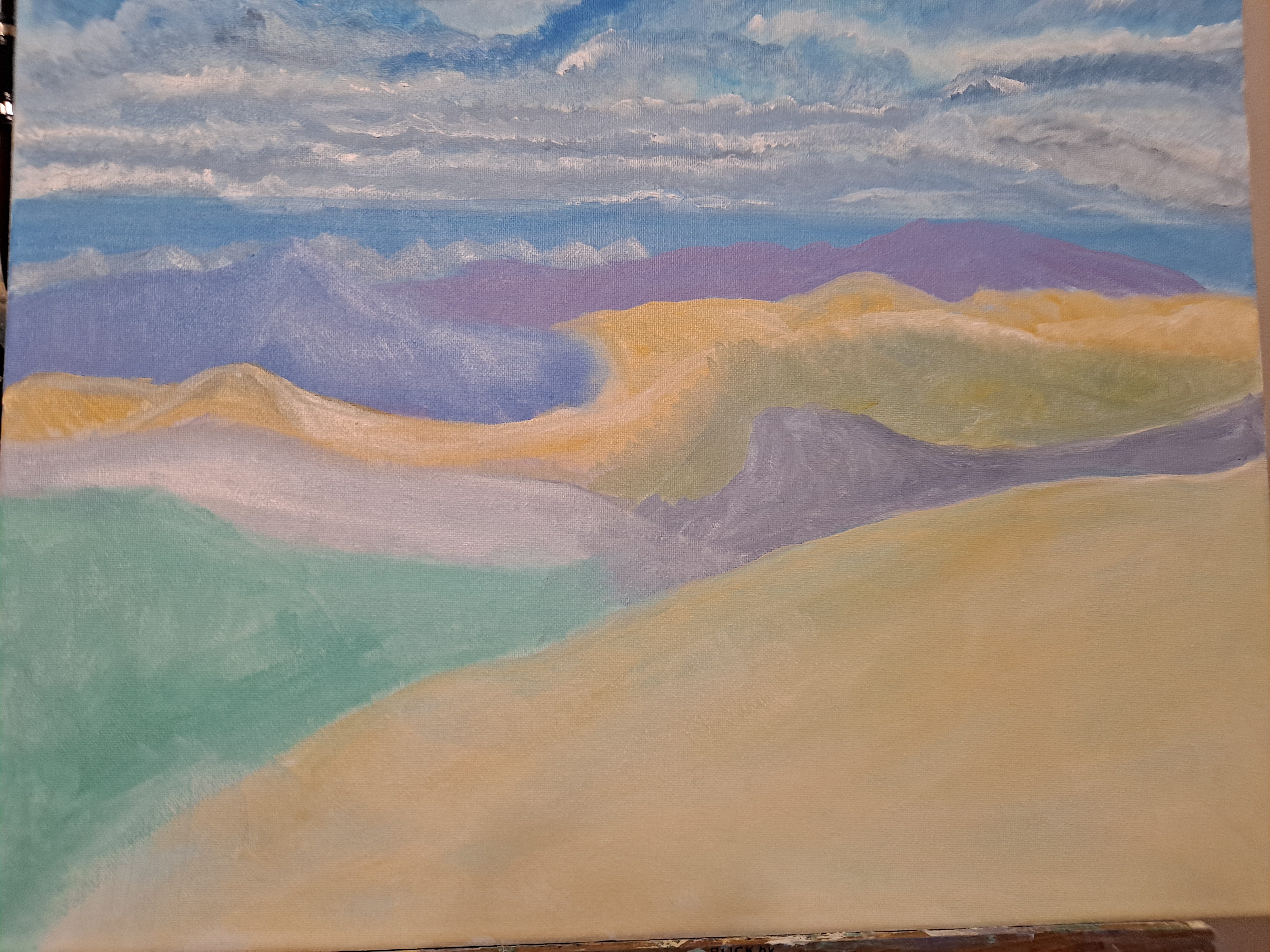
While skies are challenging for me, I reflected as I painted this one, how much I love working on skies. While it’s tempting to add more touches or make changes to this one, I don’t want to overwork it, so I’m leaving it as is. And a happy accident occurred when I added a touch of white to a certain cloud:

The rest of the landscape is less developed than the sky. Right now, the main thing I must re-learn is patience: that at this point in time, the mountains are just swaths of color that will most likely serve as the underpainting for what will be on top of them. I see opportunities for changes in mountain color and working on textured paintstrokes. Eventually, I will be adding trees and perhaps other foliage in the foreground.
Knowing myself as the novice that I am is liberating. The beauty of being a beginner is to have the freedom to experiment, to be bold, to mess up, to muddy the colors, to try even when the act of creating seems trying. The key is to keep an open mind and an open heart, to embrace learning, and to achieve growth.
This is a wonderful article Beth, it really made me think about the Zen Buddhist concept of beginner’s mind, that way of showing up with openness and curiosity, where every brushstroke feels like an invitation to discover something new. That cloud detail is a wonderful example - for me it's made the dark and light cloud almost look like it's rolling in as a wave would do at the beach.
I love how you describe the mistakes and happy accidents, because they’re exactly what keep the process alive and joyful. It’s such a reminder that being a beginner isn’t something to move past, but a way of staying playful and free, even after years of practice. This applies so much with my photography too - there are times when I've made a photograph and reviewed it while I'm out thinking I'll be deleting that one it's the 'wrong' viewpoint, over/underexposed or poorly framed or even blurring, only to see it when I get home in a different light and find it's actually a more unique way of presenting a scene. I learn from these happy accidents and experiments, and they make the process a continual learning one for me too!
99% of beginner writers stay stuck making the same 5 mistakes.
I made all of them. Wasted months. Finally figured it out.
Here's what nobody tells you:
https://open.substack.com/pub/theinnerself46/p/5-mistakes-that-keep-99-of-beginner?r=2kbdxu&utm_campaign=post&utm_medium=web